
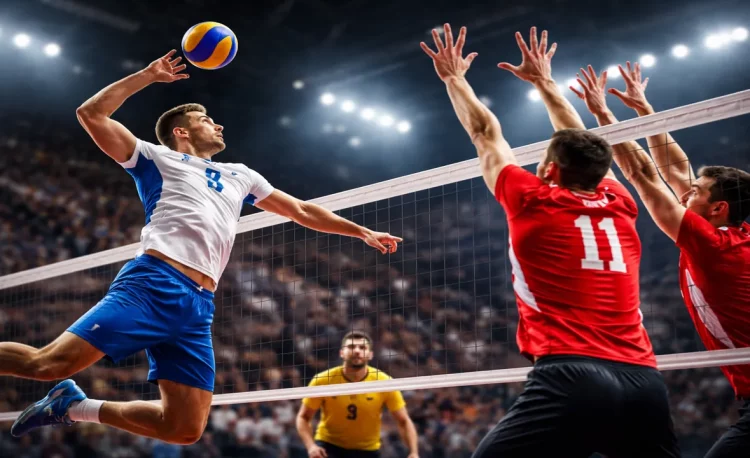
Volleyball has long moved beyond school gyms and casual beach games. It is a structured sport with clear rules, defined roles and a tactical depth that often goes unnoticed by casual viewers. To really understand how volleyball works, you need to look at the game as a system, where rules, positions, teamwork and strategy are tightly connected. This kind of structured understanding is exactly what modern sports education platforms like AcademyToday focus on, breaking down complex games into clear, practical explanations without oversimplifying them.
What volleyball is and how a match is structured
At its core, volleyball is a rally-based game where every point matters, regardless of who serves. This rule alone has changed the sport dramatically over the past two decades, making matches more intense and reducing long, uneven sets.
A standard indoor match is played as a best-of-five. The first four sets go to 25 points, while the fifth set is played to 15. In all cases, a team must win by at least two points. These numbers are not just formalities. They directly affect how teams manage risk, when they use timeouts and how aggressively they play at different stages of a set.
At professional level, even early-set decisions are calculated. Coaches track how often a team scores after specific serve types or how error rates change under pressure. Volleyball is no longer just about execution, but about timing and context.
Indoor and beach volleyball: where the differences really matter
Although they share the same basic principles, indoor and beach volleyball function as two distinct sports. The most obvious difference is the number of players, but the implications go much deeper.
In beach volleyball, two players cover the entire court. There are no specialists, no substitutions and no hiding weaker skills. Every player must serve, receive, defend and attack. Indoor volleyball, on the other hand, relies on specialization. Roles are defined, rotations are planned and substitutions are part of the tactical toolkit.
There are also structural differences that shape how the game is played.
| Aspect | Indoor volleyball | Beach volleyball |
|---|---|---|
| Players on court | 6 per team | 2 per team |
| Court size | 18×9 meters | 16×8 meters |
| Points per set | 25 | 21 |
| Block touch | Counts as a hit | Does not count |
Because of these differences, tactics that work on sand often fail indoors. The tempo, physical demands and decision-making processes are fundamentally different.
Player positions and why they define the game
Positions in indoor volleyball are not symbolic. Each role exists to solve a specific problem on the court. Modern volleyball depends heavily on specialization, especially at competitive levels.
The setter controls the rhythm of the game, deciding where and how the attack develops. A good setter can hide weaknesses and amplify strengths. Middle blockers are responsible for controlling the net, both offensively through quick attacks and defensively through timing and reading the opponent. Outside hitters carry much of the attacking and passing responsibility, while the libero anchors the defence, focusing entirely on ball control and positioning.
What often gets overlooked is how flexible these roles have become. Teams increasingly adapt their positional responsibilities depending on the opponent. Matchups, serving patterns and rotation advantages all influence how strictly roles are applied in a given match.
Core tactics that decide matches
Tactics in volleyball are dynamic. They evolve not just between matches, but during them. One of the clearest examples is serving strategy. Power serves can disrupt reception and create direct points, but they also increase error rates. Float serves are safer, yet demand precise placement to be effective.
Many teams now target specific receivers rather than zones. If data shows that one player struggles under pressure, serves are directed there repeatedly, even if it means avoiding technically weaker options.
In attack, variation is crucial. Repeating the same attacking pattern makes life easy for the block. Successful teams mix fast middle attacks, back-row options and off-speed shots to keep the defence guessing. On defence, block positioning and backcourt alignment are adjusted constantly, often based on just a few previous rallies.
Teamwork and communication on the court
Volleyball is unforgiving when it comes to coordination. One misread, one hesitation, and the rally is lost. This is why communication is as important as technical skill.
On reception, players must clearly define zones and responsibilities. In defence, calls determine who takes short balls, who covers tips and who stays deep. These decisions happen in seconds, but they are based on systems rehearsed in training.
Teams that consistently win long rallies are rarely the most athletic. More often, they are the ones that move and think as a unit. International tournaments regularly show that disciplined, well-organised teams can neutralise physically superior opponents.
How understanding the game changes match analysis
Knowing how volleyball works beneath the surface changes how matches are interpreted. A run of lost points does not always signal poor form. Sometimes it reflects a deliberate tactical risk, such as aggressive serving aimed at destabilising the opponent later in the set.
Data from top leagues shows that teams willing to take controlled risks at mid-set scores often gain an edge in tight finishes. This does not guarantee success, but it reveals intent and preparation rather than panic.
Substitutions tell a similar story. A change in the middle rotation or a temporary switch in serve-receive structure usually points to a pre-planned adjustment, not an emotional reaction from the bench.
Why volleyball keeps evolving
Over the past decade, volleyball has become faster and more analytical. Video challenges, advanced statistics and improved physical conditioning have raised the overall level of play. Attacks are quicker, defences are more organised and players are expected to contribute in multiple phases of the game.
Despite these changes, the essence of volleyball remains the same. Control of the ball, awareness of space and intelligent decision-making still define success. This balance between structure and adaptability is what makes volleyball both complex and endlessly interesting to study.